Legal Basement Apartment Renovation Requirements in Quebec
A liability-first homeowner guide for Montreal, Laval, and Saint-Laurent (2026)

A liability-first homeowner guide for Montreal, Laval, and Saint-Laurent (2026)
A “legal basement apartment” in Quebec is not one checklist. It’s a three-layer stack that homeowners routinely mix up; and that’s how projects end up with stop-work orders, failed inspections, or a “finished” unit that isn’t safe to occupy.
Here’s the only framing that stays true under scrutiny:
Not legal advice. This is a homeowner roadmap to help you ask the right questions before you demolish anything. Based on real-world experience with basement renovation work in Quebec.
Is it allowed here? In Quebec, municipal permission is the gatekeeper. “Code-compliant” doesn’t matter if zoning/bylaws don’t allow the use on your lot.
Depending on your city/borough and zone, local rules can control:
A credibility reality check: minimum size rules can exist, but they are municipal, not province-wide. For example, Saint-Laurent’s documentation includes a minimum floor area of 17 m² for a basement additional dwelling.
That’s why “minimum unit size is usually X” is not publishable as a general Quebec claim.
It’s not “only the city”. Homeowners often assume enforcement is strictly municipal. RBQ guidance notes that renovation work can be verified by municipal inspectors, and that if your work involves plumbing, gas, petroleum equipment, or an electrical installation, it may also be verified by RBQ inspectors. (Régie du bâtiment du Québec — Receiving the visit of inspectors)
Plan for municipal permits/inspections as the baseline, and don’t assume RBQ is irrelevant if your scope touches regulated systems.
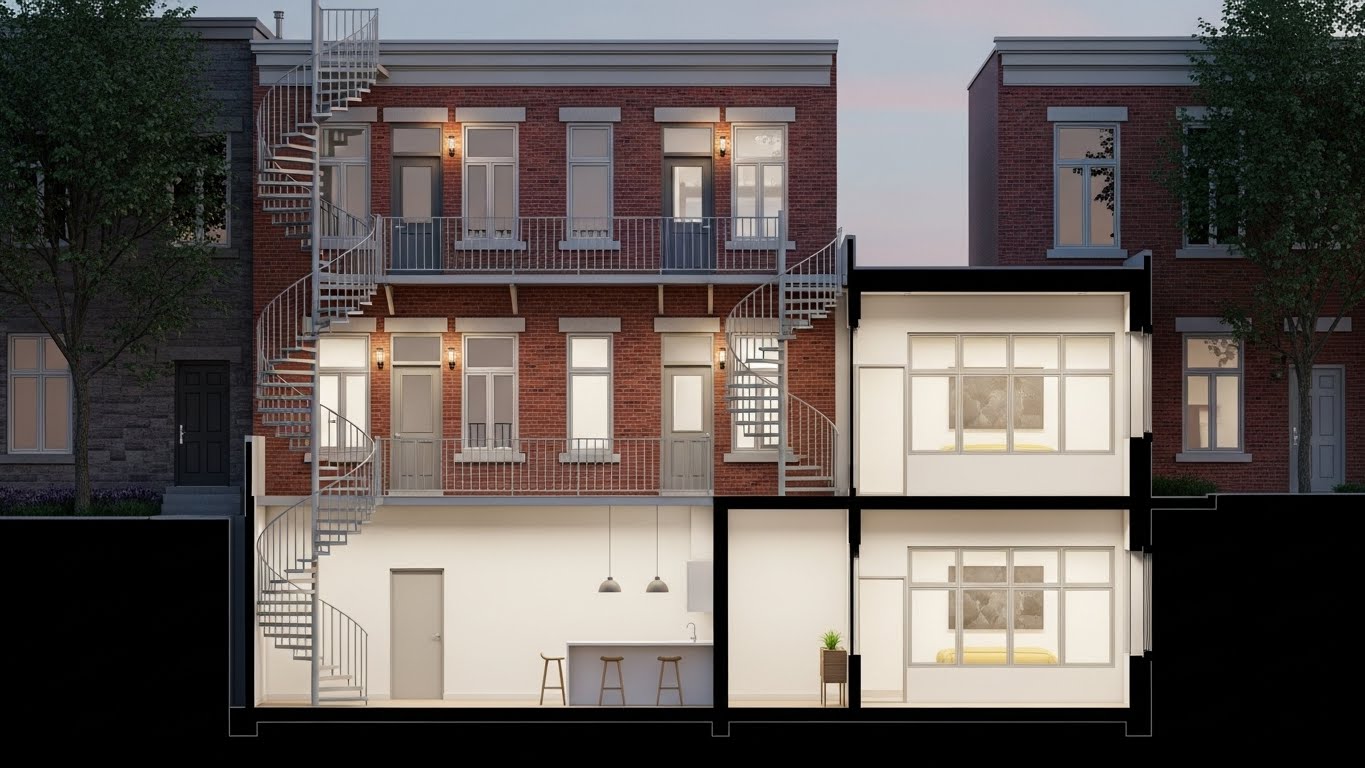
This is where you keep the project legal and safe.
Do not chase ONE magic number, ceiling height compliance depends on:
The only safe homeowner guidance is: treat headroom as a design constraint to confirm during permit plan review, not a number you “assume” early when making basement layout decisions.
Escape beats aestetics, every time. Basement suite failures often come down to one thing: the occupant cannot exit safely in an emergency.
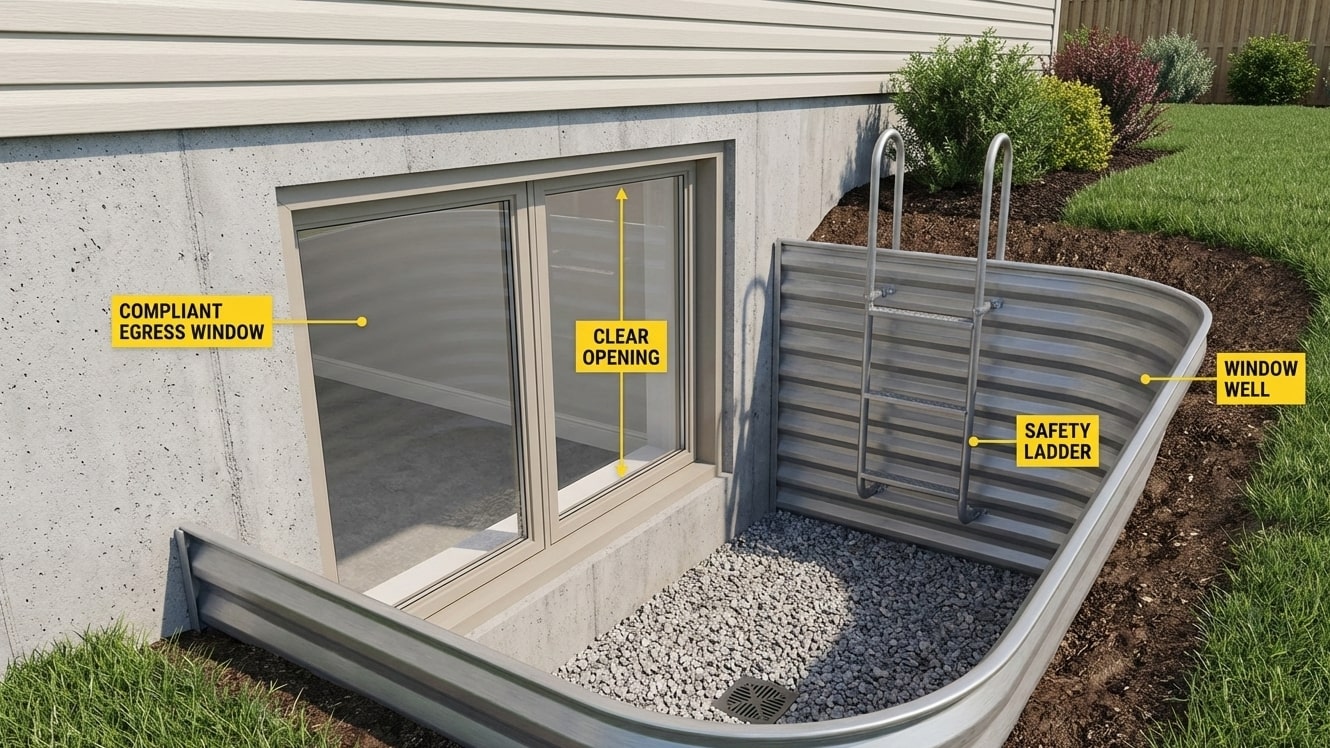
Publishable, liability-safe framing:
If you want to avoid expensive redesign: design egress first, then lay out bedrooms.
“Continuous” + “Tested Assembly” is the only safe language. Once you create another dwelling unit, you’re typically required to provide a continuous separation between units. What that separation must achieve depends on your building configuration and the applicable requirements.
Safe guidance:
Sound transmission targets are often expressed as STC/ASTC numbers in Canadian codes. For context only, code text in British Columbia includes benchmarks like ASTC 47 or STC 50 in certain conditions.
In Quebec, sound requirements are found in the Quebec Construction Code (Chapter I – Building), which adopts the National Building Code with Quebec amendments, accessible through Légis Québec and NRC Publications. Your permit reviewer uses that text to determine which sound provisions apply to your specific building type and scope. (Légis Québec — Code de construction (B-1.1, r. 2))
Seperate is smart, but not automatically required. A legal basement apartment does not automatically require fully independent HVAC/plumbing/electrical systems.
What matters is:
Separate systems can simplify compliance and tenant comfort, but calling them “mandatory” as a blanket rule is how homeowners overspend.
Not “inside every suite”. RBQ guidance on residential occupancies discusses emergency lighting for exit staircases, means of egress, and public corridors; common egress components in applicable occupancies, not automatically “inside every basement dwelling unit.”
Régie du bâtiment du Québec — Residential occupancies (Safety Code guidance)
If you want a basement apartment that’s legal and survives scrutiny, the order is boring for a reason:
Municipal permission → permit-ready plans → life-safety strategy (egress + separations + alarms) → feasibility (structure/drainage) → mechanical/electrical design → finishes.
That sequence prevents the classic failure mode: beautiful drywall built on a non-compliant layout.
If you’d rather not manage that risk yourself, Renovco handles the entire process—permits, life-safety planning, construction, and finishing—with CCQ-certified, fully insured teams and no outsourcing.
Ready or Unsure?
Need a Pro?

